
CCSE
AI/DX R&D Office †
The AI/DX Research and Development Office develops simulation technologies (materials and physical property calculations, environmental dynamics simulations) in the nuclear energy field using computational science and technology.
| Latest Topics†
- 2026-04-03 A paper on inverse estimation of radiation source concentration has been published in Journal of Synchrotron Radiation. , and a press release was issued
- 2026-03-25 A paper on a new technique for rapid measurement of the binding states of trace cesium has been published in Journal of the Japan Society for Industrial and Applied Mathematics.
- 2026-03-01 A paper on evaluation of the impact of human activities on the attenuation of ambient dose rates has been published in Journal of Environmental Radioactivity.
- 2026-02-16 A paper on elucidating the behavior of hydrogen in deformed iron has been published in .
- 2026-02-01 A paper on clarifying the factors behind seasonal variations in radioactive cesium concentration in rivers has been published in Science of The Total Environment.
- 2025-11-01 A paper on evaluation of the interaction between hydrogen and dislocations has been published in Scriota Materialia.
- 2025-10-07 A paper on quantitatively reproducting the specific heat of water through high-accuracy calculations incorporating nuclear quantum effects has been published in Jornal of Chemical Physics.
- 2025-06-27 A paper on the mechanism of specific heat anomaries in nuclear fuel using machine-learning molecular dynamics has been published in Journal of Chemical Physics, and selected as Editor's Pick. Additionally, its press release was issued.
Click here to see past updates
| Members†
- Mitsuhiro Itakura (General Manager, research map:
 , Google Scholar)
 - Masatake Yamaguchi (Scientist, research map:)
- Kenichi Ebihara (
Principal Researcher, research map:)
- Susumu Yamada (
Principal Researcher, research map:)
- Motoyuki Shiga (
Principal Researcher, research map:, Google Scholar)
- Hiroki Nakamura (
Principal Researcher, research map:)
- Masahiko Okumura (
Principal Researcher, research map
 )
) - Sasa Narimasa (Scientist, research map)
- Akiko Yamaguchi (Senior Scientist, research map:)
- Minsik Kim (Scientist, research map)
- Bo Thomsen (Scientist, research map)
- Keita Kobayashi (Senior Scientist, research map>)
- Kazuyuki Sakuma(Senior Scientist, research map>, Google Scholar)
- Rimi Konagaya(Scientist, research map)
- Sousuke Tsukazaki(Scientist, research map)
- Atsuki Hiraguchi(Scientist, research map>)
- Junhyoung Gil(Postdoctoral Fellow, research map)
- Fumihiro Imoto(Fixed Term Researcher, research map))
- Ryuta Tsunashima(Fixed Term Researcher, research map)
- Akie Mayumi(Engineer, research map)
- Masahiko Machida(Scientist, research map)
- Kimiaki Saito(Scientist, research map)
| Research Topics†
- Development of High Performance Atomic Scale Simulation Technology
- Modeling of Embrittlement in Nuclear Materials
- Investigation of Environmental Behavior of Radioisotopes
| Development of High Performance Atomic Scale Simulation Technology†
Physical properties and atomistic structure of nuclear fuel materials are required in the decommissioning activities at the Fukushima Daiichi Nuclear Power Station and in the development of advanced reactors. However, is not easy to reproduce extreme situations inside nuclear reactors and to measure properties of nuclear materials in laboratory experiments. Simulations offer an efficient alternative to experiment, and CCSE is actively developing software for and performs atomic scale numerical simulations to model the properties of nuclear materials.
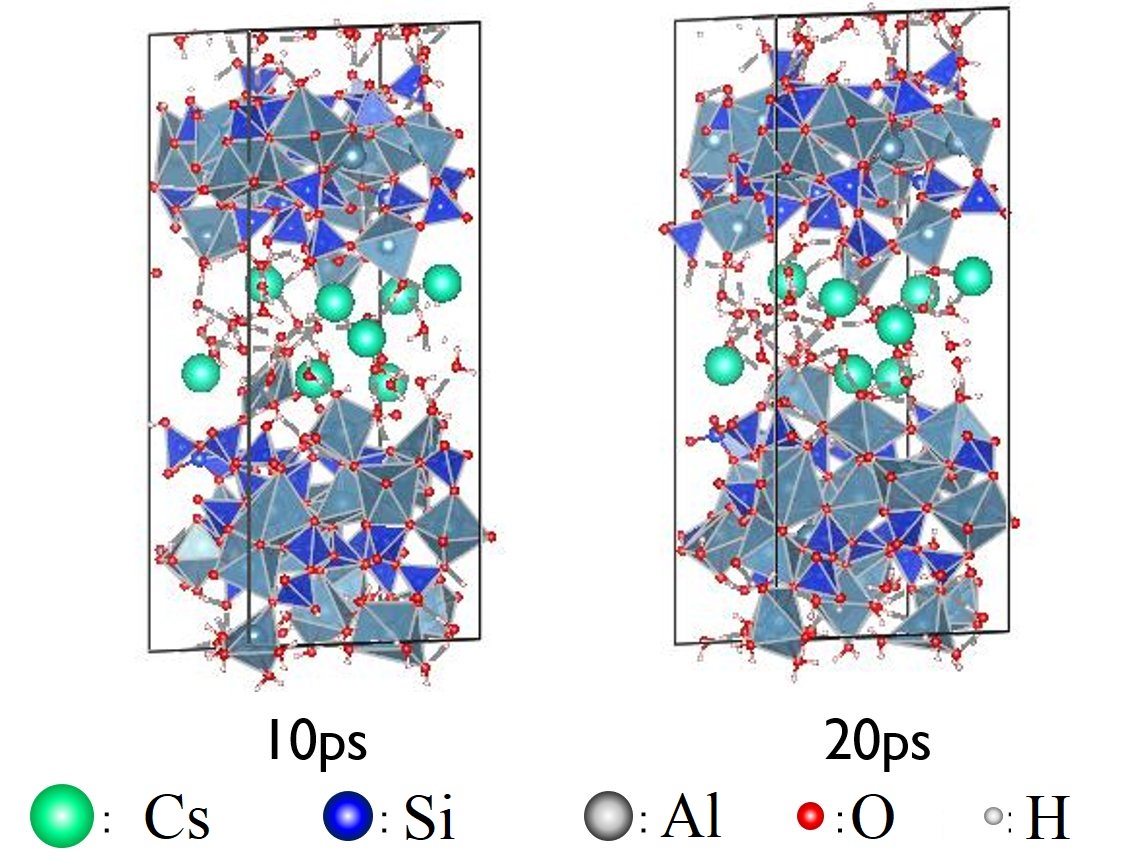
◎Elucidation of Cesium Adsorption Behavior by Machine Learning Molecular Dynamics†
In order to investigate the adsorption of cesium onto concrete inside a reactor containment vessel, we have constructed a machine-learning potential based on precise first-principles calculations. Using this potential we conducted large-scale molecular dynamics to elucidate the mechanism of cesium ion diffusion on the concrete surface.
◎Thermophysical Properties of Nuclear Fuel by Molecular Dynamics with Machine Learning Potentials†
Atomistic scale simulations utilizing machine learning potentials have been used to reproduce the high-temperature properties of thorium dioxide.
◎Efficient and Automatic Machine Learning Techniques†
In the schematic diagram below we show how the phase space is sampled using first principle calculations. The conventional way of sampling can prove intractable computationally due to the cost of ab initio calculations. In our recent publication (Nagai et al. Phys. Rev. B 96, 161102) we demonstrate a method which uses a machine learning potential to do part of the sampling. This drastically improves the time to solution. One example is phonon calculations at finite temperatures for super conductors, which are are hard to calculate with ordinary first principle based molecular dynamics. Using the scheme described here allows us to routinely carry out this type of calculation as shown in the figure on the right.

◎Open Source Software 「PIMD」†
PIMD is an open source software program developed for large scale computations and capable of carrying out a variety of high-precision calculations. This includes simulations including nuclear quantum effects and the simulation of rare events, results of which are not directly obtainable by ordinary first-principle calculations.
| Modeling of Embrittlement in Nuclear Materials†
Using large-scale first-principles calculations and molecular dynamics simulations, we are studying the characteristics of grain boundaries, dislocations, and irradiation defects in nuclear materials to clarify the dynamics and interactions on the atomic and femtosecond scale that cannot be observed experimentally to elucidate the embrittlement mechanism.
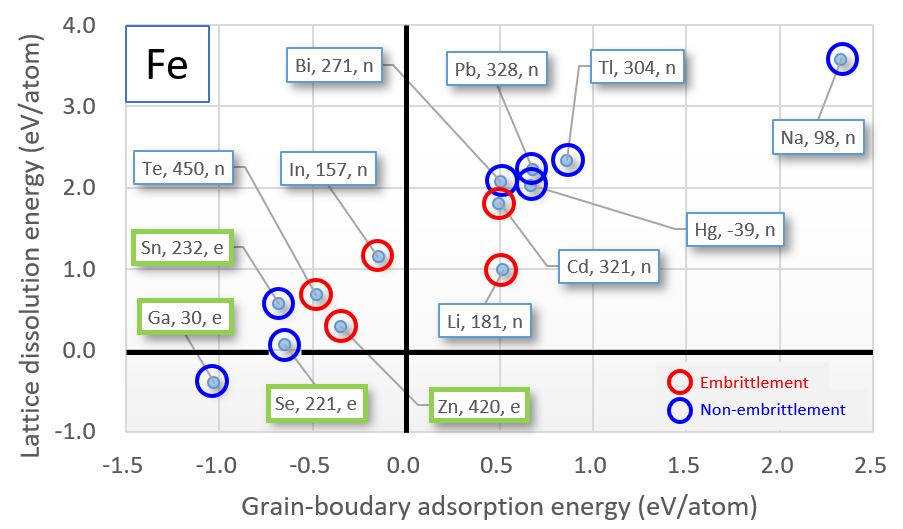
◎Liquid Metal Embrittlement†
We found that the combination of solid-liquid metal embrittlement, for which no regularity had previously been found, can be classified according to fundamental physical properties.
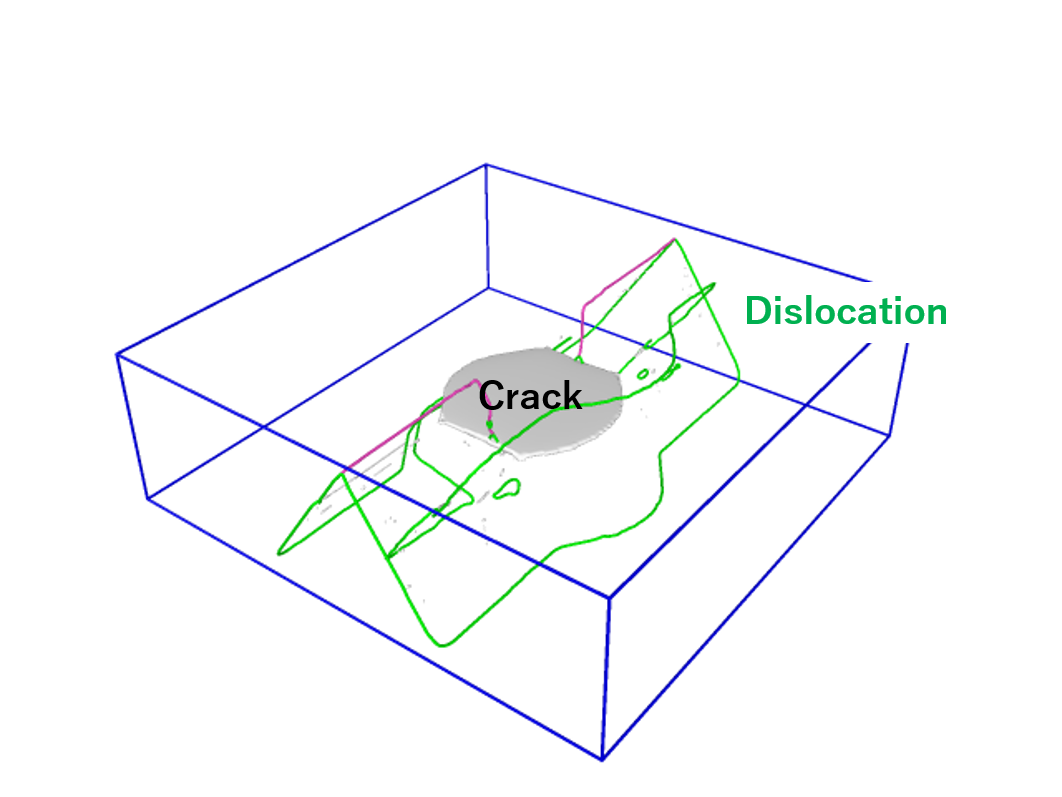
◎Crack Growth†
In experiment the (100) plane of iron is more likely to crack than the (110) plane, which is unexpected due to the lower surface energy of the (110) plane. By performing molecular dynamics simulations it was found that this was due to plastic deformation in the vicinity of the crack front along the (110) surface, making it more difficult for the cracks to propagate in this direction.
| Investigation of Environmental Behavior of Radioisotopes†
Using the latest computational science methods, we are conducting research to evaluate the future transition of radioactive elements and exposure effects in areas such as the difficult to return zone in Fukushima Prefecture.
◎Detailed Calculation of Air Dose†
We have developed a three-dimensional air dose assessment system "3D-ADRES" and created a three-dimensional model of the entirety of Fukushima Prefecture using remote sensing data such as satellite photos, topography and elevation data, and calculated air doses based on the latest findings. The figure on the right shows that locally high air doses around forests and low air doses on paved roads observed in actual measurements are reproduced in the calculation.

Map imagery (C) DigiGlobe Inc., NTT Data, Google & Zenrin 2018
◎Assessment and Prediction of Air Dose in Forests†
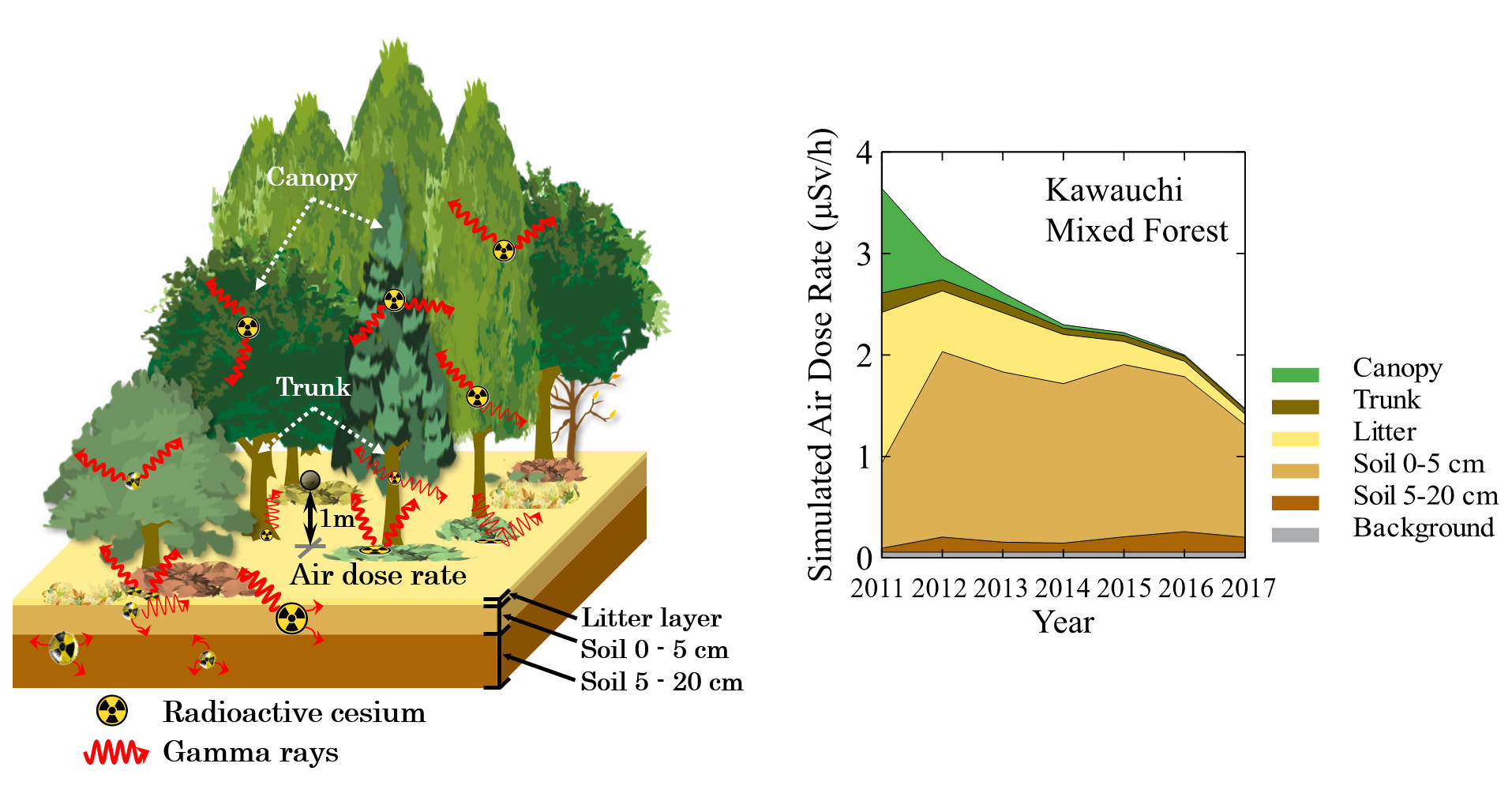
In collaboration with the Forestry and Forest Products Research Institute (FFPRI) of the Forest Research and Development Institute (FDPRI) and the University of Tsukuba, we have developed a forest model to simulate how gamma rays emitted from radioactive materials are scattered and attenuated by the soil, tree trunks, branches, and leaves in forests. Since 2015, most of the air dose rate in the forest is derived from gamma rays coming from radioactive materials in the upper 5 cm of the forest soil (right figure).
◎Environmental Behavior of Radium†
Radium is an important element which is produced from the radioactive decay of uranium and other heavy elements. It causes a number of environmental pollution problems, but in recent years it has also been used as a therapeutic agent for cancer. However, since radium exists only as a radioactive isotope, it is difficult to conduct experiments, and basic knowledge at the atomic level has been lacking. In this study, we succeeded in clarifying the radium-water distance and the coordination number of water molecules by the world's first wide-range X-ray absorption fine structure (EXAFS) measurement of hydrated radium, and in clarifying more detailed static and dynamic properties by large-scale simulations.

- A. Yamaguchi, K. Nagata, K. Kobayashi, K. Tanaka, T. Kobayashi, H. Tanida, K. Shimojo, T. Sekiguchi, Y. Kaneta, S. Matsuda, K. Yokoyama, T. Yaita, T. Yoshimura, M. Okumura, and Y. Takahashi, "Extended X-ray absorption fine structure spectroscopy measurements and ab initio molecular dynamics simulations reveal the hydration structure of the radium (II) ion." iScience 25.8 (2022): 104763, doi: 10.1016/j.isci.2022.104763.
- A. Yamaguchi, K. Kobayashi, Y. Takahashi, M. Machida, and M. Okumura, "Hydration structures of barium ions: Ab initio molecular dynamics simulations using the SCAN meta-GGA density functional and EXAFS spectroscopy studies." Chemical Physics Letters 780 (2021): 138945, doi: 10.1016/j.cplett.2021.138945.